This innocent tweet – based on official statistics from the German and Finnish telecom regulators – has currently been read by more than 90 000 people:
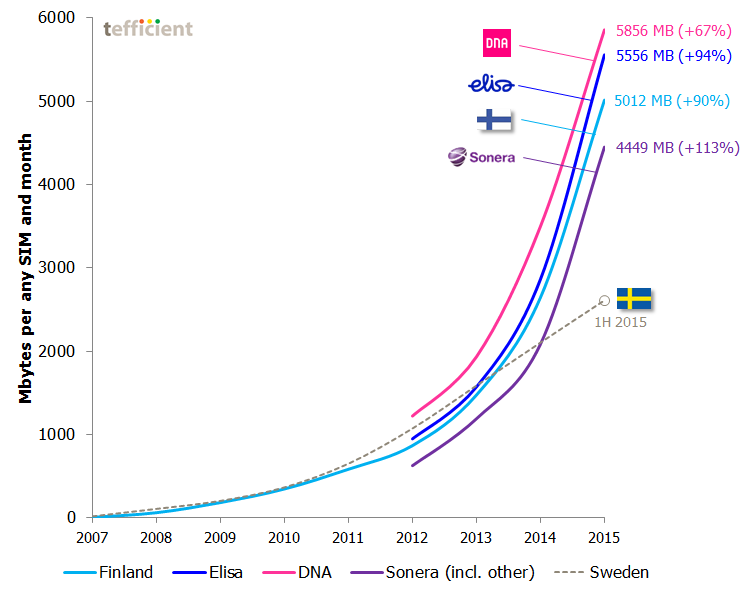
Finland, with 5.5M people, overtook Germany (with 80M) in total mobile data traffic in 2015. pic.twitter.com/fOZnEiIrLd
Even though there are some high-profiled exceptions (Verizon, most of Vodafone Group and Free to mention three), few telcos are today trusting its ability to attract all customer segments – across consumer and business markets – with one single brand.
Having one or several sub-brands has become the norm of a modern telco. In some cases, e.g. with KPN’s Telfort and TDC’s Telmore, sub-brands have been added as a result of acquisitions (often of a successful disruptive brand). In other cases, e.g. Orange’s Sosh or 3 Denmark’s Oister, telecos have themselves created the sub-brand – often with the intention to isolate the main brand from a new price fighter brand. Continue reading When your sub-brand takes over→
46% of Finnish SIMs are what the Finnish NRA calls “pay monthly subscribers with unlimited data“.
And when there are no caps or allowances hindering 46% of the Finnish devices to fully embrace mobile data, the usage growth continues: The average Finnish SIM consumed 90% more data in 2015 than in 2014.
The mobile network performance crowdsourcer OpenSignal published its latest State of LTE report today. This time it’s based on data samples from 357924 mobile users who have OpenSignal’s app on their Android devices. The network performance data isn’t just gathered when users actively do a measurement; it’s collected all the time and the number of samples are therefore hundreds of millions. The stats thus better represent the normal behavioural patterns of users when it comes to time and location. The data is collected during the fourth quarter of 2015. Continue reading Crowdsourced 4G experience: Benchmarking Nordic operators→
On 11 September 2015, Telia and Telenor announced that they had been unsuccessful in reaching an agreement with the EU Commission for Competition concerning a merger of the two operators in Denmark, which was announced 9 months earlier on 3 December 2014.
The concerns from EU presumably centered around a weakened competitive market in Denmark if Telia and Telenor were allowed to merge. As a background, the two companies had already merged their networks into a common JV called TT-Netværket.
So what has happened since – it has now been 5 months or so since the news about the failed merger? So you know what to expect in e.g. the UK and in Italy if the mobile mergers won’t be approved there. Continue reading Denmark – 5 months after the non-merger→
Why should an operator complement their customers’ experience of mobile data with Wi-Fi? To improve customer loyalty?
Wi-Fi is a positively loaded term for many users – which speaks for using it as a retention tool. But are there operators that successfully reduce churn – without using more on customer retention – by having Wi-Fi included in their mobile propositions? Continue reading Wi-Fi – the last piece of the customer retention puzzle?→
This is Anders. Like any other Swede, he’s a keen user of mobile data and likes to spend time making sure he gets as much data as possible for his money.
He frequently tethers his iPad or his Mac to his iPhone (yes, he is Swedish) to stream Netflix, HBO, Viasat and SVT Play when out and about. He’s also more or less constantly on Spotify. This behaviour means that in a normal month he uses about 6 GB of mobile data, about twice the Swedish average. Continue reading Rollover data: Solving Anders’ problems?→
Measure, compare and improve competitiveness in telecoms