For the eighth consecutive year: Comprehensive business benchmark with 890 KPIs covering revenue, OPEX, CAPEX, headcount productivity, subscriptions & channels, performance, load, quality and innovation & growth – for 54 functions of mobile, fixed/cable and integrated operators.
Peer group data exclusively from Swedish, Finnish, Norwegian and Danish operators. Due to pre-agreed confidentiality requirements, participating operators are anonymous (and of course their data).
The past three months have been a testing time for the UK mobile and broadband service providers, as many of them have battled with outages, vandalised phone masts amid lurid 5G conspiracy theories, extreme demand peaks. Store closures have placed added pressure on field, customer service and call centre staff who have been largely working from home. We all know the drill. All of us just want to get on with ‘getting back to normal’, safely past Covid-19, to life as we used to know it. But we don’t know how long it will take, or even if we will have the same breadth of services on the high street as before. Today, 15th of June, the shops are gradually and carefully opening their doors on UK high streets.
This is our fourth comparison of the mobile network experiences in the Nordics based on performance data from Opensignal. There are more details and background is the previous (one–two–three) blogs.
This time the data is gathered from March to May 2019. The data has not been published by OpenSignal but has been shared with us through Opensignal’s analyst program.
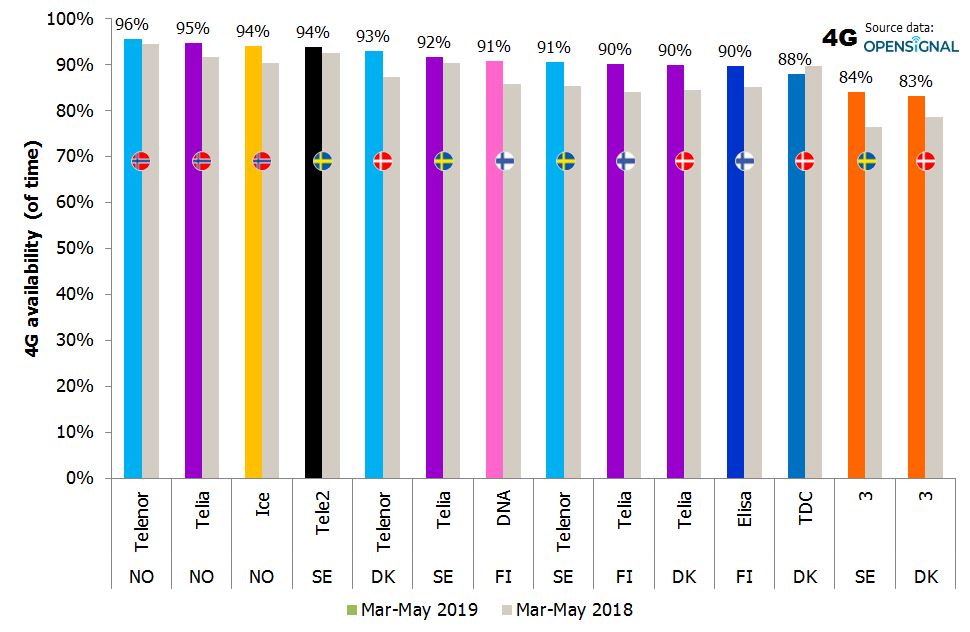
4G availability
The graph below ranks the fourteen operators in Norway, Sweden, Denmark and Finland after how large proportion of time 4G capable devices have been connected to 4G. Opensignal calls this 4G availability.
For the seventh consecutive year: Comprehensive business benchmark with 890 KPIs covering revenue, OPEX, CAPEX, headcount productivity, subscriptions & channels, performance, load, quality and innovation & growth – for 54 functions of mobile, fixed/cable and integrated operators.
Peer group data exclusively from Swedish, Finnish, Norwegian and Danish operators. Due to pre-agreed confidentiality requirements, participating operators are anonymous (and of course their data).
When we once again dive into OpenSignal‘s crowdsourced stats from the Nordics it is to see if something changed with regards to the network experiences of mobile customers in the region.
This is the third time we address this. The first blog – with data from the autumn of 2017 – contains all the background and reasoning. It was followed up by another blog based on data from the winter of 2017/18.
This time the data is gathered from March to May 2018 and covers about 490 million readings from about 15000 unique devices. The data has not been published by OpenSignal but has been shared with us through OpenSignal’s analyst program.
4G availability
The graph below ranks the fourteen operators in Norway, Sweden, Denmark and Finland after how large proportion of time 4G capable devices have been connected to 4G. OpenSignal calls this 4G availability.
Two years ago, telcos were still proudly reporting their progress in utilisation of their own public Wi-Fi hotspots for cost efficient offloading of mobile data. Public Wi-Fi was also positioned as an investment in a better customer experience – especially in public indoor environments. Telcos that were late with 4G – such as in Taiwan and Belgium – could utilise their public Wi-Fi to bridge the transition from 3G to 4G.
For the sixth consecutive year: Comprehensive business benchmark with more than 700 KPIs covering revenue, OPEX, CAPEX, headcount productivity, subscriptions & channels, performance, load, quality and innovation & growth – for 43 functions of mobile, fixed/cable and integrated operators.
Peer group data exclusively from Swedish, Finnish, Norwegian and Danish operators. Due to pre-agreed confidentiality requirements, participating operators are anonymous. Continue reading Nordic operator benchmark 2018→
Those of you that read our series of international mobile data analyses know that Finland is the country with the highest average mobile data consumption in the world.
Truly unlimited mobile data is a key explanation to this: 66% of Finland’s mobile subscriptions (excl. M2M) had unlimited mobile data in June. As a direct consequence of this Finns have developed a readiness to try out new apps and services at any location and at any time – as they never have to consider the data consumption or the associated cost. The habit of ‘Wi-Fi hunting’ is not spread in Finland.
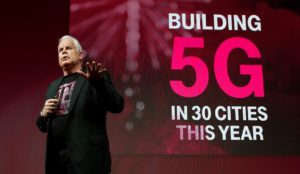
American carriers and uncarriers are embracing fixed wireless as one of the first use cases that 5G will solve. Verizon finally lifted the curtain on its fixed wireless offering yesterday: Verizon 5G Home. October 1 it will be available for 50 USD per month to existing Verizon customers in certain areas in Houston, Indianapolis, Los Angeles and Sacramento.
T-Mobile’s 5G will – to use their own words – have more ‘breadth and depth‘ than Verizon’s. With 5G, T-Mobile will position itself within fixed wireless for the first time:
“51% of Americans have only one high-speed broadband option – no choice at all! The combined company will create a viable alternative for millions by enabling mobile connections that rival broadband, driving prices lower and improving service.”
The only caveat when it comes to T-Mobile’s ambition is that it is conditional. This will happen if T-Mobile and Sprint are allowed to merge – a decision not yet made.
When we again dive into OpenSignal‘s crowdsourced stats from the Nordics it is to see if something changed with regards to the network experiences of mobile customers in the region.
This is an update of the previous version of this comparison which was based on data from the autumn of 2017. The old blog contains more background and reasoning.
The data is gathered from December 2017 to February 2018 and covers about 380 million readings from about 12000 unique devices. The data has not been published by OpenSignal but has been shared with us through OpenSignal’s analyst program.
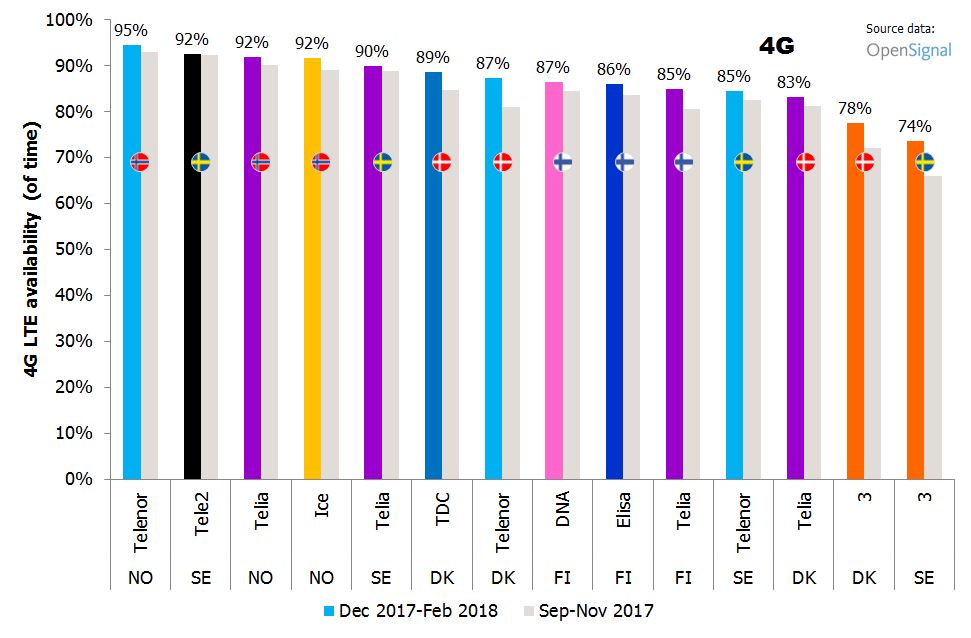
4G availability
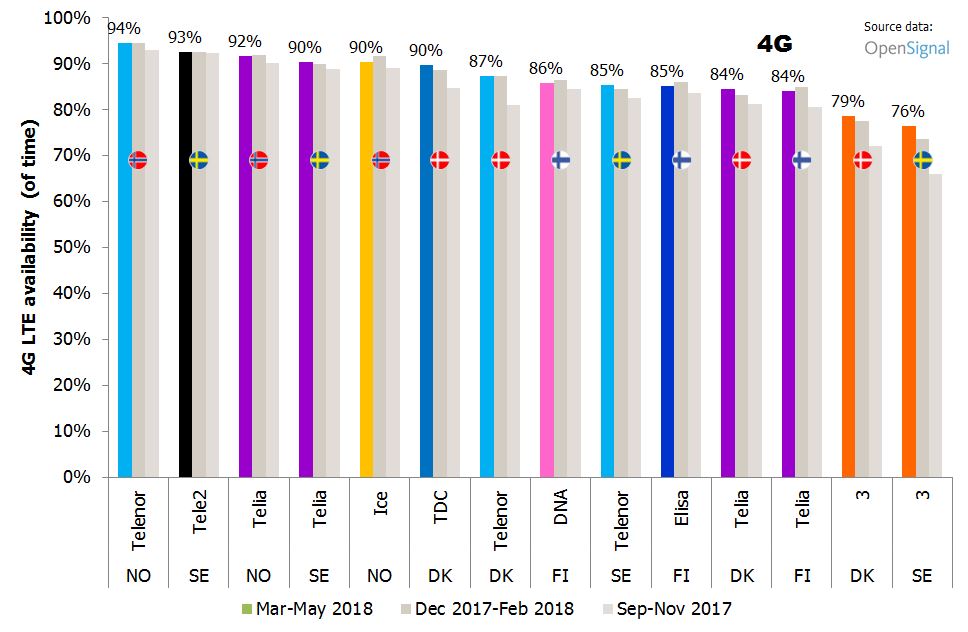
The graph below ranks the fourteen operators in Norway, Sweden, Denmark and Finland after how large proportion of time 4G LTE capable devices have been connected to 4G LTE. OpenSignal calls this 4G availability.

 Two years ago, telcos were still proudly reporting their progress in utilisation of their own public Wi-Fi hotspots for cost efficient offloading of mobile data. Public Wi-Fi was also positioned as an investment in a better customer experience – especially in public indoor environments. Telcos that were late with 4G – such as in Taiwan and Belgium – could utilise their public Wi-Fi to bridge the transition from 3G to 4G.
 For the sixth consecutive year: Comprehensive business benchmark with more than 700 KPIs covering revenue, OPEX, CAPEX, headcount productivity, subscriptions & channels, performance, load, quality and innovation & growth – for 43 functions of mobile, fixed/cable and integrated operators.


 T-Mobile’s 5G will – to use their own words – have more ‘